If you are struggling to reach behind your back, put on a coat, or sleep on your side because of severe, stiffening shoulder pain, you may be experiencing a “Frozen Shoulder.”
In the medical field, this is known as Adhesive Capsulitis. It occurs when the strong connective tissue surrounding your shoulder joint (the capsule) becomes chronically inflamed. Over time, this inflammation causes the capsule to thicken, scar, and shrink. As the tissue tightens, it literally glues the joint shut, severely restricting your mobility and causing deep, constant pain.
At a Glance: Fast Facts for Recovery
- The Issue: A painful, progressive stiffening of the shoulder joint that ruins your sleep and limits basic daily activities.
- Our Solution: Targeted, anatomy-based acupuncture to flush out joint inflammation in the early stages, combined with therapies to structurally release the joint in the later stages.
- The Goal: To reduce pain, shorten the lifespan of the condition, and prevent permanent muscle wasting in your shoulder and arm.
- Expected Timeline: Early intervention is the key for frozen shoulder, If the shoulder is already deeply frozen, conservative therapy requires a dedicated, multi-week commitment to safely restore movement.
A Clinical Note from Ruixun (Ray) Lin, L.Ac., EAMP “The true culprit behind a difficult Frozen Shoulder recovery is that it usually starts as simple stiffness, leading patients to assume it will just go away on its own. Unfortunately, by the time most people finally seek care, the shoulder has already entered the ‘freezing’ phase, and their daily range of motion is significantly restricted. The beauty of clinical acupuncture is that it meets you exactly where you are. No matter which stage of the condition you are currently in, most of the patients gain measurable outcome from the
The Four Stages of Frozen Shoulder
Frozen shoulder follows a very predictable timeline. Knowing which stage you are in helps us understand exactly what is happening inside your joint and how to effectively treat it:
Stage 1: The “Painful” Phase (0 to 3 Months) Your shoulder starts to ache, with sharp pain when you try to move it. You might notice it is getting slightly harder to reach for things, but it isn’t fully stuck yet. This is the most critical time to start acupuncture to stop the progression.
Stage 2: The “Freezing” Phase (3 to 9 Months) The pain becomes constant and intense, often disrupting your sleep. Your shoulder gets progressively stiffer, making daily tasks like getting dressed, combing your hair, or reaching for your wallet very difficult.
Stage 3: The “Frozen” Phase (9 to 15 Months) The sharp, constant pain actually starts to fade, but your shoulder feels physically “locked” in place. The joint is severely restricted, and you may find yourself shrugging your entire shoulder just to lift your arm.
Stage 4: The “Thawing” Phase (15 to 24+ Months) The extreme stiffness slowly begins to melt away, and your range of motion gradually improves. While most people do recover completely (or very close to it) within 1 to 3 years, a flawless recovery is not mathematically guaranteed. About 10% to 50% of individuals may retain minor, permanent limitations in their range of motion—especially when reaching overhead or behind the back—though these slight restrictions rarely impact daily life.
How Clinical Acupuncture Fixes the Problem
While a frozen shoulder can eventually thaw on its own, waiting up to two years takes a massive toll on your life. Furthermore, not moving your arm for that long causes your shoulder muscles to rapidly shrink and weaken (disuse atrophy).
Our evidence-based acupuncture treatments are designed to drastically shorten this timeline:
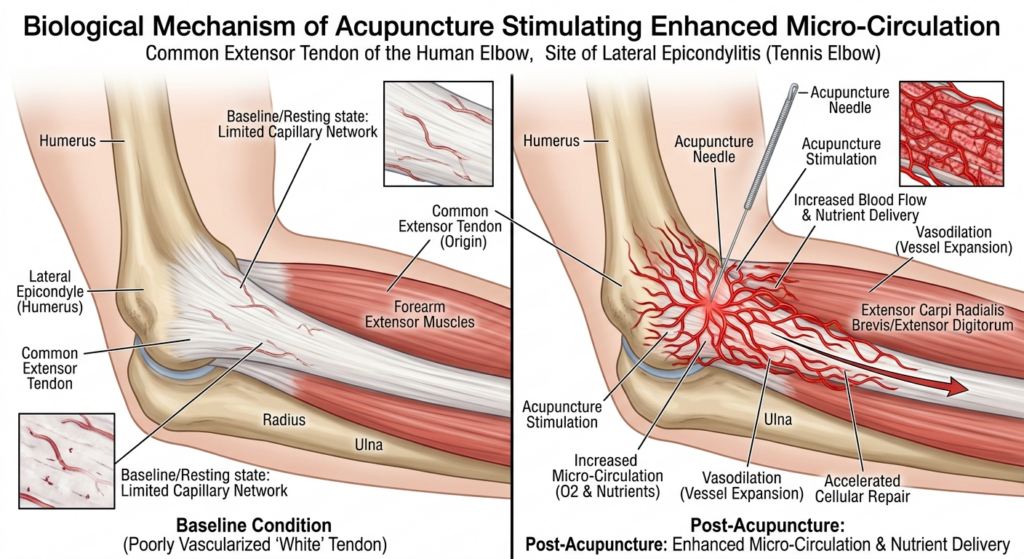
- Catching it Early (Stages 1 & 2): In the early stages, your joint is filled with a highly inflammatory fluid. Acupuncture excels here by dramatically increasing local blood circulation to flush out this inflammatory fluid before the capsule has a chance to scar and shrink. If we catch it early enough, we can often slows down the “freeze” before it sets in.
- Releasing the Joint (Stages 3 & 4): If your shoulder is already frozen, the inflammation has dried up and left behind dense scar tissue. During this phase, we use targeted acupuncture to rapidly turn off your pain signals and relax the surrounding muscles. This allows you to comfortably tolerate the movement and physical therapy required to break those adhesions apart and restore your mobility.